
Jackaroo is the board game that fills majlis evenings across Saudi Arabia and the Gulf. It looks like Ludo — four players, four marbles each, a race around a shared track into a safe zone — but there are no dice. Every move is made by playing a card, so instead of hoping for a lucky roll you plan with the hand you hold.
It is a partnership game: the two players sitting opposite each other form a team, and a team only wins when all eight of its marbles are safe. That makes Jackaroo a game of racing, blocking, knocking opponents back to the start, and swapping places at exactly the right moment with a Jack — while keeping an eye on your partner’s marbles as well as your own.
On Dananeer you can play Jackaroo free on iOS, Android and the web at play.dananeer.io. Team up with friends in a private room, join public tables with live voice and video chat, or practise offline against bots. Players on phones and on the web share the same tables, and there is no real-money gambling.
The board and the cards
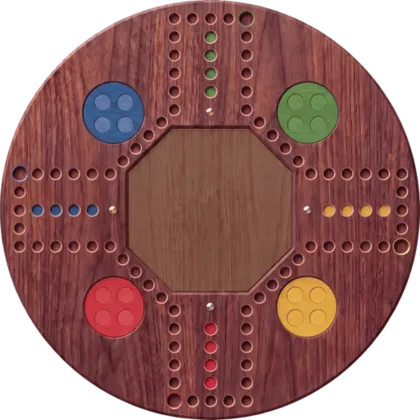
The Jackaroo board is a single shared track split into four equal quarters, one for each player. Each player has four marbles of their own colour, a home area where they wait at the start, a starting square on the track where they come out, and a four-slot safe zone just before that starting square where marbles finish.
Movement is driven by one standard 52-card deck without jokers. Each rank has a fixed job, and knowing those jobs is the heart of the game.
What each card does
| Card | Move |
|---|---|
| Ace | Bring a marble out of home, or move 1 or 11 squares forward |
| King | Bring a marble out of home (no other use) |
| Queen | Move 12 squares forward |
| Jack | Swap one of your marbles with another player’s marble |
| 10, 9, 8, 6, 5, 3, 2 | Move forward by the card’s value |
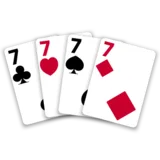
| 7 | Move 7 forward, or split the 7 between two of your marbles |
| 4 | Move 4 squares backward |
Setup and the deal
All sixteen marbles begin in their owners’ home areas. Partners sit opposite each other; at a private table, the host chooses who will be their partner before the first deal.
Each player is dealt 4 cards and play begins with the player after the dealer. When all four players have used up their cards, everyone receives 4 new cards from the stock. If the stock runs short, the played cards are shuffled back in, so the game never runs out of cards.
Objective
Bring all four of your marbles out, move them once around the board and park them in your safe zone — then help your partner do the same. The first team to have all eight marbles safe wins. There are no points to count; it is a pure race.
Playing a turn
Play is compulsory: if any card in your hand has a legal move, you must play one of those. Only when none of your cards can move anything do you burn a card — discard it without moving. If all your marbles are still at home and you hold no Ace or King, your whole hand is burned at once and you sit out until the next deal.
- Choose one card from your hand.
- Choose which marble it moves (and, for a 7 or a Jack, the second marble).
- The marble moves and the card goes onto the played pile.
- Play passes to the next player.
Getting out and moving around the board
A marble can only leave home with an Ace or a King, which places it on your starting square. From there it travels forward around the whole board towards your safe zone. You can never have two of your own marbles on your starting square, and a marble can never overtake another marble of its own colour.
The safe zone needs an exact count. You cannot overshoot the last slot, you cannot jump over a marble already sitting in the safe zone, and you cannot land on an occupied slot. Once a marble is in the safe zone it can no longer be captured or swapped.
Capturing and blocking
- Capture: landing exactly on a square occupied by another marble sends that marble back to its home — even if it belongs to your partner.
- Passing: moving past other players’ marbles is allowed, unless one of them is protected.
- Starting-square protection: a marble sitting on its own starting square cannot be passed, landed on or swapped.
- Barriers: when two marbles stand on neighbouring squares, the front one is protected — nobody can move past it or land on it.
- Taking back your square: if an opponent is sitting on your starting square, bringing a marble out with an Ace or King sends that opponent home.
The special cards in detail
- The 4 moves one marble four squares backward on the track. It never moves marbles into or out of the safe zone. Moving backward from your starting square puts that marble just a short way from your safe-zone entrance.
- The 7 can move one marble 7 squares, or be split between two of your marbles, for example 3 and 4. Both parts must be legal, and each part can capture.
- The Jack swaps one of your marbles on the track with any other player’s marble on the track, opponent or partner. Marbles at home, in a safe zone, on their own starting square or otherwise protected cannot be swapped. A swap never captures.
- The Ace is the most flexible card: it can bring a marble out, make a small 1-square adjustment, or jump 11 squares.
Helping your partner and winning
When all four of your marbles are in your safe zone you are not finished: from then on the cards you play move your partner’s marbles instead. The team wins the moment all eight of its marbles are safe, so a player who finishes first becomes their partner’s best helper.
Each turn is timed. At a private table the host can adjust the turn timer, but the board and rules stay the same.
Strategy tips
- Get marbles out early. A hand with no Ace or King and nothing on the board is wasted, so bring out new marbles while you have the cards.
- Use the 4 from your starting square: going backward four squares brings a marble almost to your safe zone in one move.
- Save the Jack for a big swing — trading your marble at the back for an opponent who is about to reach their safe zone can change the whole game.
- Don’t leave a lone marble sitting a short distance in front of an opponent; any card that lands exactly on it will send you back home.
- Park a marble on your starting square or line up two marbles side by side to build a barrier that slows the other team down.
- Keep flexible cards like the Ace and the 7 for the tight moves into your safe zone, where you need an exact count.
Frequently asked questions
How many players are needed for Jackaroo?
Jackaroo is played by exactly four players in two teams of two. Partners sit opposite each other; offline, bots take the other three seats.
Which cards bring a marble out in Jackaroo?
Only the Ace and the King. The Ace can alternatively move 1 or 11 squares, while the King has no other use.
What does the Jack do in Jackaroo?
The Jack swaps one of your marbles on the track with another player’s marble. Protected marbles and marbles at home or in a safe zone cannot be swapped.
What does the 4 do in Jackaroo?
The 4 moves a marble four squares backward. Moving back from your starting square puts that marble close to your safe zone.
Can you split a 7 in Jackaroo?
Yes. You can move one marble 7 squares or split the seven between two of your marbles, as long as both parts are legal moves.
What happens if I cannot move in Jackaroo?
If none of your cards has a legal move, you burn one card without moving. If all your marbles are at home and you have no Ace or King, your whole hand is burned.
How do you win Jackaroo?
Your team wins when all eight of its marbles are in their safe zones. Once your own four are safe, you use your cards to move your partner’s marbles.
Can I play Jackaroo online for free?
Yes. Jackaroo is free on Dananeer for iOS, Android and the web at play.dananeer.io, with voice and video chat, private rooms and offline play against bots.