
Okey 51, known in Turkish as elli bir okey, is the quick, aggressive sibling of Okey 101. It is played across Turkey, Iraq and the Middle East with the same 106-tile set, and like Okey 101 it lets you lay melds on the table mid-deal and add tiles to other players' melds. The difference is the opening bar: you only need 51 points for your first lay-down, so hands open early and every deal becomes a race.
Okey 51's signature rule is the rising bar. The first player to open with runs and sets needs 51 points, but each player who opens after them has to beat the previous opener's total. Open late and you need a bigger hand. You can also skip the points race by opening with four pairs, and just like Okey 101, any tile you take from the discard pile must be melded that same turn.
Play Okey 51 online free on Dananeer, on iPhone, Android or in your browser at play.dananeer.io. Invite friends to a private room and talk over live voice and video chat, jump into a public table, or practise 51 Okey offline against bots. Dananeer is free and has no real-money gambling.
Okey 51 tiles and the okey joker
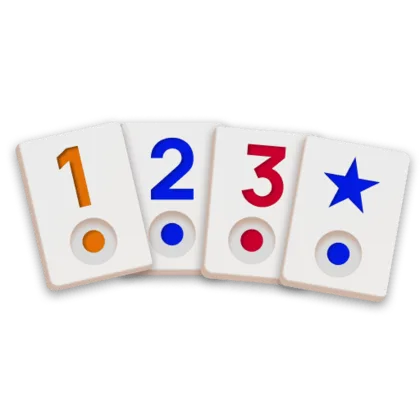
Okey 51 uses the standard 106-tile Okey set: 104 numbered tiles in four colours, thirteen ranks per colour, two identical copies of each, plus two false-joker tiles.
After the deal one tile is turned face up as the indicator. It stays visible all deal and is removed from play. The indicator sets the okey: the tile of the indicator's colour next to it in rank. Both copies of the okey are wild and can replace any tile in a meld.
Setup and deal
There are no teams in Okey 51; every player scores for themself, and play goes clockwise.
- Shuffle the tiles and deal the hands. The first player (the one after the dealer) gets one extra tile.
- Turn up the indicator to set the okey for the deal.
- The remaining tiles form the face-down draw pile, and every player has their own empty discard pile.
- The opening bar is reset so that the first opener of the deal needs 51 points.
- The first player already holds the extra tile, so they skip the draw and start by melding (if they wish) and discarding.
Objective of Okey 51
Be the first to empty your hand, with every tile melded on the table or added to a meld and your last tile discarded. The winner scores below zero, losers take penalties, and after the final deal the player with the lowest total wins the match.
How to play a turn
- Draw one tile: from the central draw pile, or the top tile of your own discard pile (the tile the previous player threw to you).
- Optionally open, lay down more melds, or add tiles to melds on the table.
- Discard one tile onto the next player's discard pile. You must keep a tile to throw, unless you are laying down your whole hand to win.
- A tile you take from your discard pile must be melded that same turn. Until it is, you cannot discard.
- Changed your mind? Discarding the exact tile you took hands it back to your pile, and you draw again.
Runs, sets and pairs
- Run: 3 to 13 tiles of one colour in consecutive order, such as 7-8-9 in yellow.
- Set: 3 or 4 tiles of the same rank in different colours.
- A run laid from your hand can be at most 5 tiles; longer runs go down in parts, and can grow to 13 on the table.
- The okey fills any gap, but a meld cannot start with two wilds.
- Pair: two non-wild tiles of the same rank, used only for a pairs opening.
Opening with 51 points and the rising bar
Your first lay-down of the deal is your opening. The first player to open with runs and sets needs at least 51 points. After that the bar rises: each later player who opens with runs and sets must lay down more points than the previous opener did. The bar starts again from 51 at the beginning of every deal.
- Pairs opening: lay down at least 4 pairs instead. It ignores the bar and does not raise it for anyone else. Lose the deal after a pairs opening and your penalty doubles; win it and the deal doubles.
- Finish-hand opening: lay down your whole hand in valid melds at once, whatever its value. It does not raise the bar either.
- After opening, meld with no minimum and add tiles to any opened player's melds. Players who have not opened may not add to melds.
- Joker steal: swap a real tile for the okey in a meld on the table and take the okey into your hand.
| Tile | Points |
|---|---|
| 2 to 9 | Face value (2–9) |
| 10, J, Q, K, A | 10 each |
| Okey inside a meld | Value of the tile it replaces |
Special finishes: elden and the okey discard
- Elden: go out in one move without having opened earlier in the deal and the deal's scoring doubles.
- Finish on the okey: if your winning discard is the okey, the deal's scoring doubles.
- An elden finish that ends with the okey discard makes the deal worth four times as much.
Okey 51 scoring
Okey 51 is a low-score-wins game. The winner of a deal takes a negative score. A loser who never opened takes a heavy flat penalty, while a loser who opened pays the points of the tiles left in hand plus a large penalty for every okey still loose in hand. The winner's finish then sets a multiplier for the whole deal.
- A loser who opened with pairs has their own penalty doubled on top of the winner's multiplier.
| Winner's finish | Deal multiplier |
|---|---|
| Plain finish | ×1 |
| Finished by discarding the okey | ×2 |
| Elden (one-move finish without opening) | ×2 |
| Winner opened with pairs | ×2 |
| Elden and finished on the okey | ×4 |
Winning the match
A standard Okey 51 match is 11 deals. The winner of each deal plays first in the next. Scores are added up across all deals, and the lowest total at the end wins; players tied at the lowest total share the win.
How Okey 51 differs from Okey 101
Okey 51 and Okey 101 are the same game with three rules changed. Everything else, from the discard lock to meld shapes, special finishes and match length, is the same.
| Okey 101 | Okey 51 | |
|---|---|---|
| Points to open | 101 | 51 for the first opener |
| Pairs to open | 5 | 4 |
| Rising bar | No, 101 all deal for everyone | Yes, each later opener must beat the previous one |
Strategy tips
- Open early. With the rising bar, every player who opens before you makes your own opening harder.
- If an opponent opens big, switch plans: four pairs ignore the bar entirely.
- Build with 10s and picture tiles, worth 10 each, to clear the bar quickly.
- Only take a discard you can meld this turn; otherwise you will have to hand it straight back.
- Do not sit on a loose okey near the end of a deal; it is one of the costliest tiles to be caught holding.
- If you are close to a complete hand and still unopened, going out elden in a single move doubles the deal in your favour.
Frequently asked questions
How many points do you need to open in Okey 51?
The first player to open with runs and sets needs at least 51 points. Every later opener must beat the previous opener's total.
What is the rising bar in Okey 51?
Each time a player opens with runs and sets, the next player to open that way must lay down more points than they did. The bar starts over at 51 every deal.
Can you open with pairs in Okey 51?
Yes, with at least 4 pairs. A pairs opening ignores the bar and does not raise it, but it doubles your penalty if you lose the deal.
What is the difference between Okey 51 and Okey 101?
Okey 51 opens at 51 points with a rising bar and 4 pairs, while Okey 101 opens at a flat 101 points or 5 pairs. The rest of the rules are the same.
How many tiles are in Okey 51?
Okey 51 uses the standard 106-tile set: 104 numbered tiles in four colours with two copies of each, plus two false jokers.
Can I play Okey 51 offline?
Yes. On Dananeer you can play Okey 51 offline against bots, or online with friends in private rooms with voice and video chat.
Is Okey 51 free to play?
Yes, Dananeer is free on iPhone, Android and the web, with no real-money gambling.